Aurealis
The ball is a particle of the solar wind and the bricks are atoms that emit light when excited: every photon paints a piece of aurora. From Earth to Triton, in 900 rounds.
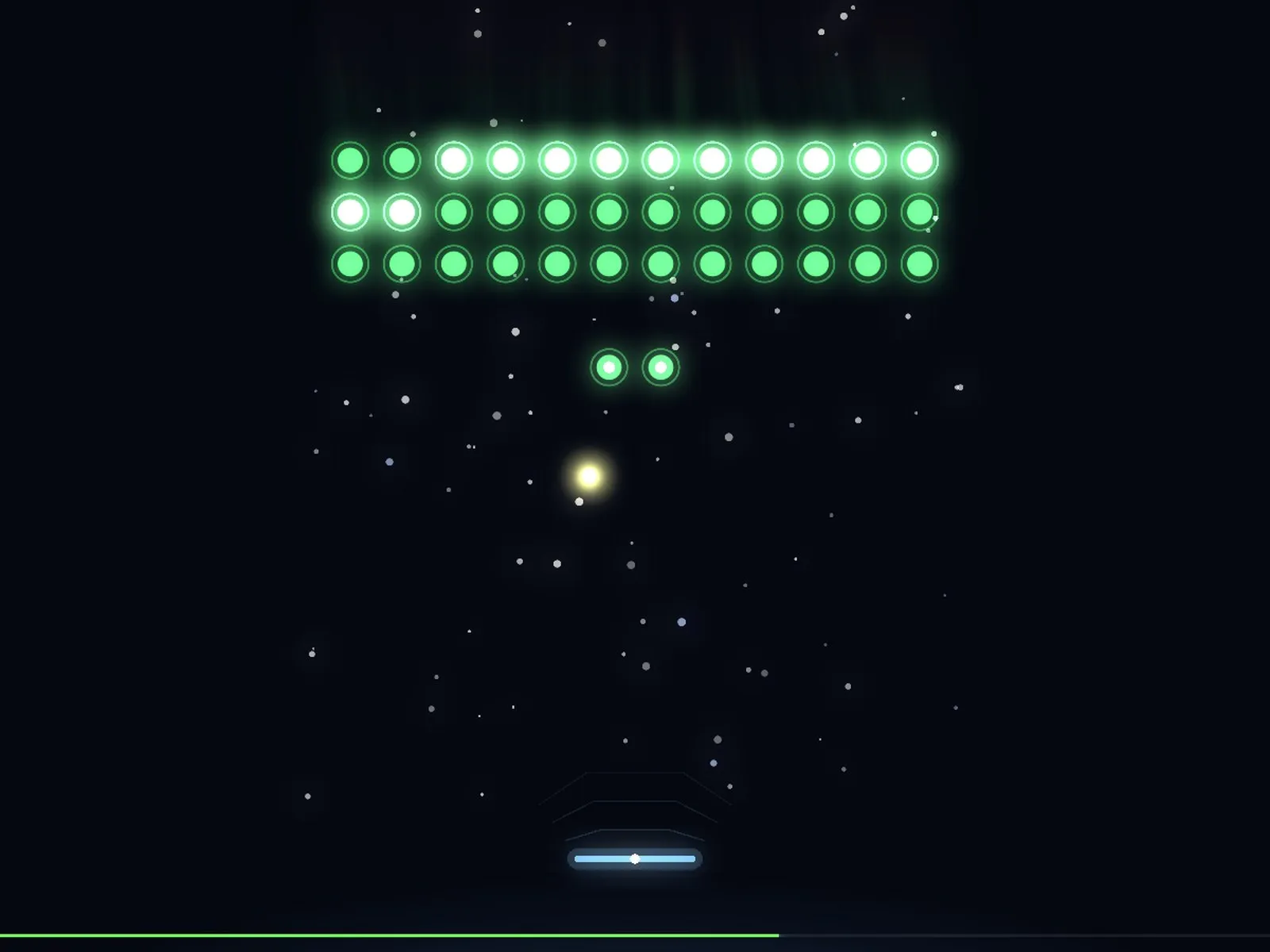
The particle carries energy and loses some in every collision; the paddle is the magnetic field’s mirror point, which bounces it back and recharges it. Atoms have quantised thresholds: green oxygen (557.7 nm, which takes seven tenths to emit), red oxygen (630 nm, quenched if you touch it too soon), blue and purple nitrogen, hydrogen that leaves you uncharged, sodium in its layer. Wave mode: the particle spreads, crosses dense layers and, after two slits, collapses into fringes. Entangled pairs that light together, tunnelling, ions that release another particle.
900 rounds in 90 chapters: Earth, the quantum world and five planets (Jupiter, Mars, Saturn, Uranus and Neptune), each with its own species and physics (the footprints of Jupiter’s moons, the dust of Mars, the spokes of Saturn’s rings, the polar night of Uranus, the winds of Neptune), and five moons (the Moon, Io, Europa, Titan and Triton), where gravity is so weak that the game lies on its side and you play with two paddles. An endless Storm measured in Kp, a workshop where credits make capsules last longer and a checked physics fact every round, gathered in the Notebook. Drawn with PixiJS 8 on WebGPU or WebGL: the aurora curtain is a custom shader that grows with every photon.
- Inventory no.
- LAB-23
- Year
- 2026
- Technique
- Astro
- Vue 3
- PixiJS 8 (WebGPU / WebGL 2)
- Shaders WGSL + GLSL
- Web Audio (synthesis)
- Gamepad API
- PWA
- Device
- Mobile and desktop
- Browsers
- Current browsers
- Permissions
- None
- Status
- Experimental
- Address
- aurealis.alexharto.com